

- What is 3D Printing?
- Why is Nitrogen Used for 3D Printing?
- Uses of Nitrogen in 3D Printing
- Can Other Gases Be Used Instead of Nitrogen?
- Required Purity of Nitrogen for 3D Printing
- Nitrogen Consumption & Pressure
- Sources of Nitrogen for 3D Printing
- Why PSA Nitrogen Generators Are the Best Choice
- Conclusion
- FAQs
What is 3D Printing?
3D printing, also known as additive manufacturing, is the process of creating three-dimensional objects from a digital design by layering materials sequentially. This innovative technology is widely used in industries such as aerospace, automotive, healthcare, and manufacturing.
Why is Nitrogen Used for 3D Printing?
During 3D printing, especially in processes like Selective Laser Sintering (SLS) and Direct Metal Laser Sintering (DMLS), oxygen must be displaced to prevent oxidation. Nitrogen is an ideal choice because:
Inert Atmosphere
Prevents oxidation and ensures material integrity
Enhanced Print Quality
Reduces defects and improves precision
Cost-Effective
Compared to argon and helium
Uses of Nitrogen in 3D Printing
| Application | Benefit |
|---|---|
| Oxygen Displacement | Prevents oxidation and material degradation |
| Inert Atmosphere | Reduces thermal deformation, ensuring precise prints |
| Improved Safety | Eliminates fire hazards associated with reactive metals |
| Better Product Quality | Ensures dimensional accuracy and reduces material wastage |
Can Other Gases Be Used Instead of Nitrogen?
Yes, other gases like argon and helium can be used, but nitrogen remains the most cost-effective option.
| Gas | Cost Comparison |
|---|---|
| Nitrogen | Most economical |
| Argon | ~100x costlier than nitrogen |
| Helium | ~1000x costlier than nitrogen |
Required Purity of Nitrogen for 3D Printing
The recommended nitrogen purity levels for 3D printing applications range from 99.5% to 99.9%. Higher purity levels are generally not required and can increase operational costs unnecessarily.
Nitrogen Consumption & Pressure in 3D Printing
📊 Key Specifications:
- Nitrogen Consumption: Average of 5-7 Nm³/hr (depends on printer specifications)
- Nitrogen Pressure: 0.5 to 1.5 Kg/cm²g required to maintain optimal printing conditions
Sources of Nitrogen for 3D Printing
Traditional sources of nitrogen include:
| Source | Cost Efficiency | Supply Continuity |
|---|---|---|
| Gas Cylinders | Expensive | Limited |
| Liquid Nitrogen Tanks | Expensive | Continuous but requires refilling |
| PSA Nitrogen Generators | Cost-effective | Continuous supply |
💡 Is High-Purity Nitrogen Necessary? While 99.99% or 99.999% purity nitrogen can be used, it is often unnecessary for most 3D printing applications. The cost of nitrogen increases significantly with higher purity levels.
| Nitrogen Purity | Cost per Nm³ (Approx.) |
|---|---|
| 95% | ₹1.76 |
| 99.5% | ₹2.6 |
| 99.9995% | ₹10.56 |
Why PSA Nitrogen Generators Are the Best Choice
PSA (Pressure Swing Adsorption) nitrogen generators provide an efficient and cost-effective way to produce nitrogen on-site, making them the best choice for 3D printing. Their advantages include:
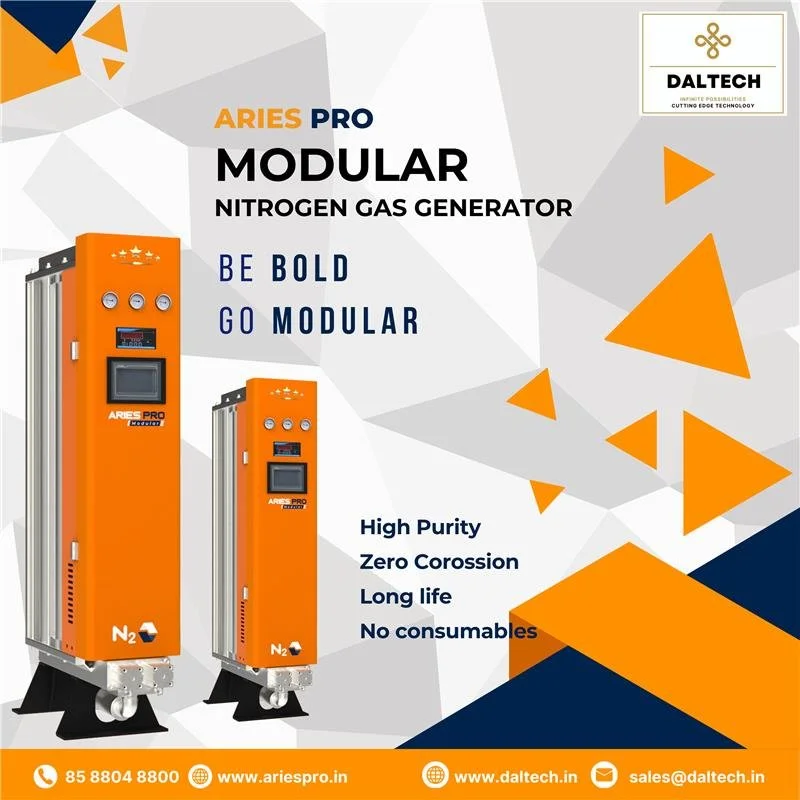
Our N₂ Solution – ARIES PRO Modular Nitrogen Generator
For businesses looking for an efficient nitrogen supply, the ARIES PRO Modular Nitrogen Generator offers:
Conclusion
Nitrogen plays a crucial role in 3D printing by preventing oxidation, improving product quality, and ensuring a stable inert atmosphere. While traditional nitrogen sources like cylinders and liquid tanks have been used, on-site PSA nitrogen generators like ARIES PRO provide the most cost-effective and reliable alternative.